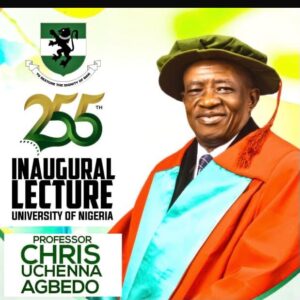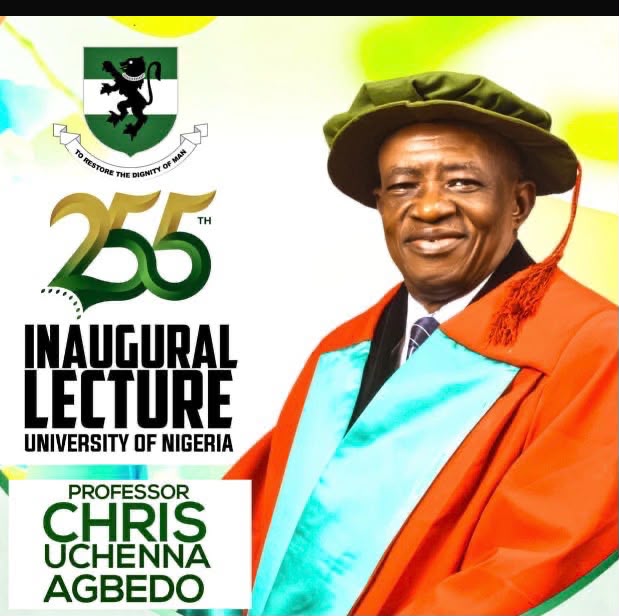
The University of Nigeria, Nsukka (UNN), will on Thursday, 5 November 2026, host the 255th Inaugural Lecture of the University, to be delivered by Professor Chris Uchenna Agbedo, PhD, FNIAS, Professor of Sociolinguistics and Psycholinguistics, at the Princess Alexandra Auditorium and Theatre, University of Nigeria, Nsukka, beginning at 12 noon Nigerian time.
Titled “WordMatters: Sociolinguistic Calculus as a Praxis for Interrogating Linguistic Banditry and Banditisation of Nigeria,” the lecture promises an intellectually compelling interrogation of the relationship between language, power, public consciousness and the social consequences of meaning-making. At its heart lies a deceptively simple but profoundly consequential proposition: words do not merely describe the world; they can shape how the world is perceived, interpreted, justified and ultimately transformed.
In an age when political rhetoric competes with public accountability, institutional pronouncements influence collective judgement, and images increasingly mediate civic understanding, Professor Agbedo’s lecture invites the audience to look beyond what words say to what they enable. It raises a fundamental question for contemporary society: when language becomes an instrument of manipulation, euphemism or calculated misrepresentation, how can critical inquiry recover the distinction between what is said, what is meant and what is made possible?
Beyond Words: The Architecture of Sociolinguistic Calculus
The lecture advances Sociolinguistic Calculus as an intellectual and analytical praxis for examining how language acquires social force, how meanings migrate across contexts, and how linguistic choices may be deployed to construct realities, conceal responsibility, legitimise questionable conduct or normalise otherwise unacceptable propositions.
For Professor Agbedo, meaning is neither fixed nor innocent. A word may begin as description, acquire the force of accusation, evolve into justification and eventually become embedded in public consciousness as conventional wisdom. In this progression, language ceases to be a neutral vehicle of communication and becomes a site of contestation, negotiation and power.
The concept of linguistic banditry foregrounds the problematic appropriation, distortion and strategic manipulation of language, particularly where expressions are deployed to mislead, evade accountability or disguise the implications of public action. Its companion concept, banditisation, directs attention to the processes through which such manipulative practices become normalised, reproduced and institutionalised within the wider sociopolitical environment.
Rather than treating these phenomena as isolated abuses of vocabulary, the lecture situates them within a broader framework of discourse, context, institutional authority and public consequence. Its central concern is not merely whether a statement is grammatically sound or rhetorically persuasive, but whether its meaning withstands scrutiny, what assumptions it conceals, whose interests it advances and what consequences its circulation produces.
Five Vectors, One Intellectual Continuum
A distinctive feature of the lecture is its articulation of five interconnected intellectual vectors through which Sociolinguistic Calculus moves from linguistic analysis to social interpretation and critical intervention.
WordMatters establishes the foundational proposition that language matters because words can name, frame, persuade, conceal, provoke and legitimise. It examines how linguistic choices shape perception and influence the boundaries of acceptable public discourse.
Critical Lens introduces the discipline of interrogation. It challenges the uncritical acceptance of statements merely because they are confidently expressed, repeatedly circulated or pronounced by authoritative institutions. Evidence, context, omission, implication and competing interpretations become indispensable instruments of analysis.
ConnectingDots extends the inquiry beyond isolated utterances. By connecting the speaker, the statement, the institution, the historical circumstances and the eventual consequences, it reconstructs the relationships through which meaning becomes socially significant. The objective is contextual reasoning rather than speculative association: making visible the connections that fragmented reading may obscure.
Verses on Canvas opens the inquiry to visual communication. It recognises that images, colours, spatial arrangements, gestures and juxtapositions communicate meanings that may be difficult to capture through words alone. In this framework, the public sphere becomes a visual text in which power, contradiction, aspiration and failure are continuously represented and contested.
BrushStrokes completes the continuum through satire, incongruity and visual provocation. Its purpose is not simply to entertain but to unsettle complacency, disrupt familiar assumptions and stimulate critical inference. A satirical image may appear humorous on the surface while carrying a serious civic argument beneath it.
Together, these five vectors establish a deliberate progression: from the word to critical interpretation, from interpretation to contextual connection, and from connection to visual representation and public intervention.
Visual Pragmatics: Language Reaches a New Frontier
The convergence of the five vectors points towards what Professor Agbedo identifies as Visual Pragmatics, an emerging frontier in his intellectual framework. Here, the analytical boundaries of language are extended to encompass the visual forms through which societies communicate, negotiate power and construct public meaning. The premise is that society itself can be read as a text. Political speeches, newspaper headlines, institutional statements, public performances, photographs, cartoons and carefully composed images all participate in the production and circulation of meaning.
The interpretive challenge, therefore, is no longer confined to decoding sentences. It involves understanding how verbal and visual signs interact with context, how audiences draw inferences, and how institutional power can amplify particular interpretations while marginalising others.
In this expanded framework, the word tells, the image shows, context clarifies, inference completes, and power gives meaning consequence. The ultimate measure of interpretation becomes not simply what a statement means, but what that meaning does in the world. This perspective carries implications for sociolinguistics, political communication, media analysis, civic education and the broader struggle for accountable public discourse. By foregrounding the relationship between linguistic choices and social consequences, the lecture seeks to sharpen the tools with which citizens, scholars and institutions interrogate public claims and resist the uncritical normalisation of manipulative narratives.
An Invitation to Follow the Trail
Professor Agbedo’s 255th Inaugural Lecture is positioned as both a scholarly milestone and an invitation to sustained public reflection. It brings together language, critical reasoning, contextual analysis, visual communication and satire within a unified framework for understanding how meaning operates in society.
Its larger intellectual challenge is captured in a question that resonates far beyond the lecture hall: what happens when words travel from speeches into public consciousness, from public consciousness into institutional decisions, and from institutional decisions into the lived realities of citizens?
The lecture will take place on Thursday, 5 November 2026, at 12 noon Nigerian time, at the Princess Alexandra Auditorium and Theatre, University of Nigeria, Nsukka. Members of the university community, scholars, students, media practitioners, policymakers and the general public are invited to participate in this important intellectual engagement. The invitation is to follow a trail, from word to world, and to consider whether the most consequential calculation in public life lies not merely in what we say, but in what our saying makes possible.